Showing posts with label Reflections on Teaching. Show all posts

Tuesday, October 6, 2015

Making Math More Like Science

This is my second time teaching Grade 7 Science, and once again I am blown away with the simplicity of the material but how it "blows our brains" as my students explain. As a class we have spent days talking about The Particle Theory. These 5 postulates have caused us to question everything from why does it take longer to make a cold tea than hot to the fact that we are made of the same stuff of dinosaurs. What would seem like 5 simple rules has caused all students in the class to question, explore and expand their thinking.

Having taught math for the majority of my career, I am used to parents and students feeling that the same enrichment and challenge only comes from the exploration of material beyond the curriculum. We have to leave the material of Grade 7 so that a student can become equally engrossed and inquisitive about the material as their peers. However, from observing my Science students I challenge this full heartedly. As we explore the same concepts of Science, each student is driving their thinking forward from their own questions. No new material is being presented to them, but they are using their current knowledge to ask questions and see how they can apply this thinking to the world around them. The difference I see from this and a math class is that math does not encourage student driven questions. There is a sense that an order must occur in the learning of material and that the teacher should guide it. I want to put this thinking in the garbage this year and make it so that math and science are structured in the same manner; the presentation of foundational concepts and the time for students to explore and make connections on their own.

This will be a challenge. I know from personal experience that students are taught to ask questions in science since these exhibit wonder and excitement about the material. Asking questions in math class could have a very different reaction from peers and the teacher. It could indicate an inability to grasp the concept, not able to focus on the prescribed task or "not what we are thinking of at the moment". Students, and parents, are trained to learn, practice and then perform rather than the science of learn, question, explore and perform.

To do this I have made my students first math project to be one where they need to ask their own question where proportional reasoning is the base. How far they push and go with the ideas is up to them. My last blog post goes into more details of the project. However, over this past week I am more convinced that a great exploration and student driven activities are necessary in math classes to develop the math students my high school coworkers are hoping to have come their way. They are wanting to have the thinkers, and not just the calculators.

Friday, July 17, 2015

End of Year Reflections

With my first year teaching Grade 7 Math and Science over, I have come away really loving this year. Compared with my past few years where I have taught four or five classes, working with only two classes over two subjects and homeroom made the year feel quite different. I felt that I worked more closely with the students, parents and supports in the school due to having half of the number of faces and stories to work with. Yes, the downside is that I didn't get a chance to meet the whole grade, but I am looking forward to being in the same class and having the same set up next year. With this in mind, I have made my "Affirm, Refine and Aspire" for next year. 

Affirm:
The big thing that was affirmed for me this year is that I do love Middle School. I really enjoy how my students are wanting independence in their learning, want to explore the world around them, play games and challenge themselves, me and their peers. I also love how forgiving this age group is if you are honest with them. I have learned that once they feel you are on the same "team" as them, they will be alright with me saying "hey, I want to try something out today. I think that it will be fun, and I look forward to your feedback afterwards". They are concerned about their performance, but are open to seeing and focusing on their personal growth and goal setting rather than a percentage grade at the end. 

Refine:
This year I focused on assessment and evaluation; its purpose, goals and outcomes in my class. I started, with the support of my teaching team, using a Standards Based Grading (SBG) platform with my class. This method meshed perfectly with my Challenge by Choice activities as well as my strong belief in creating opportunities at any point for students to demonstrate their understanding. Going into next year, I want to refine how I will be using SBG. I will start the year with using Fresh Grade, a program to organize the evaluations and assessments as well as the standards. I am considering giving students the list of goals at the start of each unit and encouraging them to track their own growth over the year and take ownership over their learning. From using a quiz goal list in Khan Academy I have seen how my students used it to take the responsibility in their learning and review. I am hoping that the same thing will be possible in their "Learning Goals" (Standards) 

Aspire:
My mind, as it always has, always goes BIG with my ideas and goals. However, what has happened is that my big thinking and great ideas are great, but they also don't provide the time and breathing room for my students big ideas and personal exploration. I am setting the goal for next year to be more "Grade 7". To me this means that I am not trying to get my students to create final products that are reflective of a Grade 10, but ones that are reflective of each person at Grade 7. To do this, I am planning on taking the first three months of the school year to show my students the thinking routines, goal setting and essential skills (such as research, communication, and group work) that they will need for the year. After this, I am hoping to create more open ended projects, questions and ideas that my students will use tools described before to explore and communicate their learning. I also want to aspire to more individual check in time with students, going over their goals and what they are doing to meet the goals over time. 

To help with my goals, I am taking time over the summer to learning. I am taking the online course called "Science and Cooking" to get Grade 7 ideas for creating experiments that my students will do at home and explain the science to their families. I will explore Standard Based Grading further by reading Rick Wormeli and I am also looking at online tools that would be the best for my students to track their learning.

I also am setting the goal of taking more time for my own reflection over the year, and trying to do a better job on my blog. I want to track my thinking and development going forward so I can be better at explaining how I got to the end to others when they ask.

Hope that you all have a great summer! 


Saturday, October 26, 2013

Flipped Mastery: Finding a Balance for Middle School Students

For my upcoming unit of Patterning and Algebra, I have decided to run the class on a Mastery Method. I have spent the past two weeks setting up the program, marking plan, support materials and just released it to the students this week. I was surprised to then see two articles posted this weekend, one from the New York Times and the other from David Wees which both made me reflect upon my methods and goals.

The New York Times article In 'Flipped' Classrooms, a Method for Mastery, Tina Rosenberg summarized the challenge of a traditional class room as "the teacher must aim the lecture at the middle, leaving the faster learners bored and the slower ones lost". I have enjoyed using a Challenge by Choice approach to differentiate my teaching for my students. They select the level of challenge and support that they would like when learning a new concept. The issue I was having with using this method was that I was dictating which concepts we were learning and when. Students still enjoyed selecting their level of challenge as they could move slower or faster depending on their personal needs at that time with that concept.

However, looking forward to our algebra unit, I know that my students are coming from a wide range of backgrounds, and some have already covered this material. Due to this I wanted to provide the Challenge by Choice teaching style, but also with the student selecting which concept they wanted to explore and when. My solution to doing this was to combine the Challenge by Choice with a Mastery Method of teaching.

To make this happen, I have broken down the unit concepts into small, understandable steps for my students, each with their personal copy. I took this idea from Dan Meyer after reading his post about his checklists for students to track their learning. Students are made aware of which concepts we will be exploring in the upcoming week via an email and announcement on Friday. If students want to, they can go to another document that outlines videos that I have made or found as well as practice questions about this topic. They can explore the concepts ahead of time, practice, and then come to class knowing what kind of support they would like to have (Green, Blue or Black). When I introduce the concept, students can then decide if they would like to explore the concept together, or if they would like to move ahead and explore an additional concept through online resources, in class activities or with peers. As stated in the Times article, putting this together has been almost having another job, but I know that by having the resources available will allow the students to move at their own pace.

The plan for tracking the students progress is through the use of Mastery Quizzes. Students will sign up each week and identify which mastery quiz they would like to complete. These are formative and they can take them as many times as they like. To be a master, they need to get 4/4 on the concept twice. Students track their progress on their concept check list sheet and I do the same in my notes. It is through these quizzes that students can show me that they already have understood a concept and so they do not need to be in the Green group with me, but can move ahead. If a student has not preformed a mastery quiz on that concept, they are indicating that they would like some support walking through the concept.

In the end, all the students will still write a signature assessment (test) displaying their understanding of the unit. The difference is that they can select how they progress from the start of the unit until the end, not having to move at the same pace.

David Wees made some valid points in his post that made me reflect on my plan to use online resources like Khan for students to practice.  David identified the following challenges of only using online assessments or learning tools when looking at its use at his son's school:
  • It did not measure his ability to explain his reasoning to others.
  • It did not ask him to show multiple solutions for finding his answer.
  • It did not present a meaningful context, and measure my son's ability to apply his understanding to that context.
  • It did not check to see if my son had gained any transferable understanding.
  • It did not allow my son to talk to peers about his solution.
I am going to keep David's comments in my head as I move forward. My goal is to ensure that those students that are moving ahead are also needing to think collaboratively and be challenged when in the Black or Blue groups. I will remember to think that online tools should be used as a way for them to track their own learning, but not as the way for them to display it. 

If you have any experience with a Mastery based program, I would love to hear or read about your experience and appreciate any advice you can give. 

Sunday, October 20, 2013

My Grade Book: Tracking Progress, Not Product

This year I am trying out a new way to set up my grade book. My goal is to better see the progress my students are having in the class, identify areas where they are being challenged and provide extensions when they are showing mastery.

My grade book last year looked something like this:


Formative Fractions:
Quiz Sept 15 (/12)
Formative Percentages:
Quiz Sept 30 (/15)
Summative:
Test Oct 6 (/35)
Student X
7 = 58%

Knowledge: 2/3
Thinking: 1/3
Application: 2/3
Communication: 2/3
12 = 80%

Knowledge: 3/5
Thinking: 3/3
Application: 4/5
Communication: 2/2
29 = 82.5%

Knowledge: 13/15
Thinking: 6/7
Application: 5/8
Communication: 5/5
In Ontario, each of our assessments are broken into four learning categories; Knowledge, Thinking, Application and Communication (Achievement Charts). Even though with this method, I am able to see that my students greatest area of challenge is in the application area but I can not be specific with my feedback about what concepts, or steps they should take to improve. I can only be general or have to sit down and go through the assessment with them to identify how they could improve. I found that a week later, I would only know that I would need to help this student with their application questions, but I would have no background as to specific concepts, or past areas of concern to adjust my teaching methods. 

To help give a better picture of each student and their progress and growth, I looked to Standards Based Grading for support. My school does not grade using this method, but I thought that if I used it in my personal grade book, it would help provide more meaning to my grades and therefore impact my teaching. My school grade book still looks like the one above, but now my grade book for each unit will look like the following:

Diagnostic9abcd4b,7a,b8a8b7b53, 4a
1st AssessFormative1ab1c1d1b2
2nd assess
3rd assess
First NameLast NameAlgebra AwarenessAdd and subtract fractionsMultiply fractionsDivide fractionsConvert improper to mixed fractionsCreate equivalent fractionsOrder rational number
StudentANCVG
VG
NI
VG - formative
NC
VG - formative
VG
VG
G - mixed challengeG - issue in boxes
VG - formative
StudentBGuess and checkVG
VG
VG
VG
VG
VG
VG
VG
VGVG
VG
This was the first few columns and refer specifically to specific concepts. As you move further along in the grade book, it then shows results for applications of rational numbers from word problems etc. 

With a lot more lines, it looked more confusing and more work, but I feel it provides a deeper picture into each of my students. I have put more emphasis on the concepts, taken directly from the curriculum, and now break up my assessments into these rather than the other way around. I have also indicated what question on each assessment referred to each concept. This way I can also ensure that each concept will be assessed multiple times and that students have been given feedback. Now a story can now be told about each learner:

Student A:
  • From her diagnostic, Student A showed that she was comfortable with adding and subtracting fractions even when there was an improper fraction involved. However, she showed that she needed improvement in multiplying and dividing fractions as well as the rational number on a number line. Specific support was provided for these areas, and with the second assessment she has shown improvements. The student can be congratulated specifically on her improvement in each area.
Student B:
  • From the diagnostic it was aware that this student already had the skills in these areas. Throughout the following class activities, she was encouraged to challenge herself with Blue or Black level activities. In her following assessment she continued to show a very good understanding of the concept and she will be encouraged to explore these ideas further with individualized questions. 

For me, it helped to see if students were continuing to struggle on a specific concept and more direct instruction or support was necessary. Also, I am able to say to Student A:

 "I saw that you have made a great improvement in your dividing fractions. Thats great! What did you do to make those improvements?". 

By identifying their specific achievements, I hope that we can celebrate together, but also reflect on their process. How did they improve in this area? What strategies did they use? What resources? When a student sees that they are the ones that made that improvement, I am hoping I can refer back to it when they may come across a challenge in the future. Also it allows me to celebrate each student because each one will hopefully show a progress on one concept even if their overall result is not displaying this. 

If you have a way to break down your grade book into specific concepts that is working for you, please let me know. I am hoping to make changes throughout the year to something that communicates the learning process.

Sunday, September 15, 2013

Bansho: Applying Primary School Strategies to MS Math classes

A quick summary of a Bansho from my understanding would be that students solve a problem, share their unique solutions to the rest of the class allowing the teacher to identify various strategies and methods that could be used. The teacher consolidates the methods by creating a summary of a good strategy by identifying or combining various students work. Students then take ownership over the work and feel it is possible to understand since a peer/peers were the originators of the ideas.


I decided to use a Bansho as a way to assess what skills and understanding students had about percentages. I did the Bansho on the first day of class (lesson plan here) also to create the sharing and collaborative culture that exists in my Grade 8 classroom. As students went through the period, they experienced the values of creativity, perseverance and selected challenge. I created a small slide show to guide the work (found here) and and wrapped up with only four questions for homework.

I adapted the idea of the Bansho that I was introduced to match both my teaching style and needs. By using this method I was able to see more than just who was able to solve the problem, but also able to see the following:

  • Clear awareness of students who have been taught in a procedural method
  • Risk taking abilities
  • Number sense abilities
  • Ability to explain and justify their ideas
  • Ability to see similarities and differences in mathematical procedures
  • Ability to make connections to prior knowledge
  • Preferred learning style (visual, oral, etc)
  • Prior understandings
  • Introverts/extroverts
For an activity that took only 50 minutes, it provided me with a better understanding of who my students were and allowed me to flag students who needed both support and a greater level of challenge and where that would need to take place. More than I have ever done on the first day of class. 

Upon reflection I would say that a Bansho would be a valuable teaching strategy for all grade levels. In the high school level it would be a beneficial activity prior to introducing a new functions, rates of change, geometry proofs, to beginning calculus. By asking the students to come up with as many different solutions to a problem you could see their understanding of previous concepts, ability to compare methods to each other and analyze what aspects of various methods create a more accurate and useful solution. For me since the Bansho, I was able to understand how my students already viewed proportional relationship problems and then teach to their methods directly. Overall a great experience and one that I highly recommend to all teachers at all teaching levels. 

Learning from other divisions. How I learned about Bansho.


Last year I attended a OAME conference (Ontario Associate of Mathematic Education) and participated in a "Mathematical Literacy" group. Sitting among the teachers, I quickly realized that I was the only middle school teacher, or pretty much the only teacher that was above the Grade 5 level. As the presentation proceeded, my eyes were popping out of my head as I was seeing strategies that I felt would bring the clarity and ownership of mathematical procedural learning to my students.

However, as I looked around to the other teachers, I saw that they were not as interested as I was. When questioned as to why they weren't as "blown away", one women sitting at my table said "Honey, I've been doing this in my class for 10 years. This isn't new information to me.". A few sessions later, I was sitting in a session meant for Grade 11 and 12 teachers only this time I was the one telling those senior school teachers that the "amazing" strategies that they were being introduced to were common practice in middle school classrooms. It was at this point that I realized the valuable strategies that work for students are not being used or applied beyond the designated Primary, Junior, Intermediate and Senior divisions. So I made it a goal to see what I could take and use from the Primary/Junior divisions, as those are the areas that I have never taught in. And this is how I was introduced to a Bansho.

Sunday, September 8, 2013

Back to school and New Goals

New school year, means a fresh start and of course the creation of goals for the year. For me, this is my first year that I will be teaching in the same school as I was in June. Also it is my first year teaching the same grade and curriculum. With my goals usually being something surrounding me trying to "figure things out" and "stay on my feet", I can now slow down my pace and take a look around. It feels great to be able to look ahead to the whole year, able to picture it, but with that also comes with the awareness of what could be lying around the corner. One of my students said it best when sharing her hopes and fears for the Grade 8 year. She indicated that in Grade 7 she had many fears and hopes since everything was new, but now that she knows about the school and the expectations, they are bigger hopes and even bigger fears. Being aware of what is around the corner, didn't make things easier, just made her more aware of what was to come. 

For me my goals are the following:
  1. Remain flexible. Just because I can see beyond the week, doesn't mean that I need to lock myself into any set ideas or plans. A strength I feel I had from my previous years was the idea of things can always change, and I always need to be open to that change.
  2. Use my resources more. We have a great Junior school in my building. I hope to go and see how they work through their math curriculum with the students and see what skills I can gain from them. Also I hope to continue reading my RSS feed each sunday which has consistently introduced me to new and creative thinkers. 
  3. Fine tune and challenge my Challenge by Choice (Green/Blue/Black) program. Ever since being introduced to it while living in Jakarta by David Suarez, I have adapted it to fit my teaching style, resources and students. Now applying it in the same school, two years in a row, I can really explore and make bigger changes to fit my students.
  4. Keep in touch with my online professional community. Last year I was apart of a program geared to help teachers develop a blog. It was the encouragement I needed to do something that was a goal for a while. Now that I am out of the program, I hope to keep up the reflection and communication as best I can. I have changed the site (using blogger) and hope to gain any suggestions.
So here is to a great year. As my roommate on the ship said so well after finishing our first semester, "The first bit we just tried to survive. Now we can truly live the experience". And with living, my buy-in is greater, making the highs even higher.

Hangout with Formative Feedback - A personal youtube video for feedback

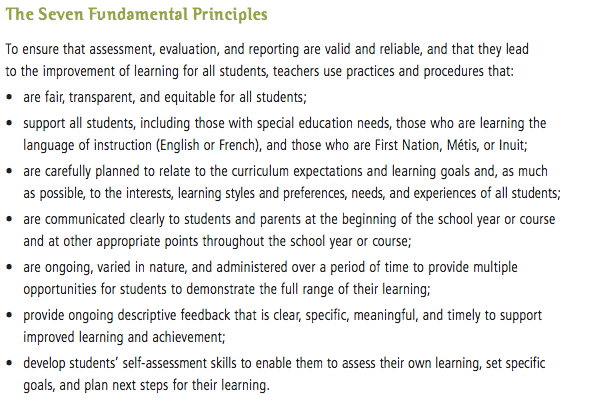
For those teachers in Ontario, you are well aware of the Growing Success document that was published in 2010 and is the guide for how assessment and evaluation is implemented in our schools. Having taught overseas for my first years as a teacher, I came back to Ontario in 2011  lucky to learn the document and participate in PD at the same time as my colleagues. Here is a summary of the 7 fundamental principals.

7 fundamental principals


This year my goal was to develop the last principal. I wrote about my experience and process in my previous post  and also the experience of the 13 year old student driving there education. The one challenge that I had with this last principal what how the students were using the diagnostics, formative check ins, class conversations activities to identify their needs. I found that my written feedback was not having as great an impact for the amount of time and effort I was putting into the work.

My goal was to have the students think through the feedback that I had given them and develop an internal conversation about how they could improve. A teacher friend of mine told me that she would highlight areas on student work and ask them to think about why she had done so, causing them to reflect on their own work. I liked her suggestion and wanted to do the same thing with my students. My challenge was that I was hoping to give differentiated feedback, asking students to revisit key concepts, but also to challenge other students to show their thinking or show them new ways to communicate their ideas. So I decided to make marks on their work, but follow it up with a guiding conversation afterwards... for each student. One on one conversations are not possible in class, so I decided to video tape my feedback to the students. But with limited computer space to save so many files and a challenge to share them, I looked for options on the internet where I came across Google hangouts and Youtube streaming.

The solution is a personal video, recorded directly on youtube and sent as a private link to my student to watch, comment and use for their feedback. It was a one step process from recording the video to sending a link automatically to my students without any uploading or fancy editing. Here is how I did it:

  1. Add Google Hangouts to your chrome apps
  2. Open a new hangout, name it and ensure that you also say that it is a private video.
  3. Record the video
  4. Send the link of the private video to your student
  5. Track the "views" to see if your student was able to watch it. Also you can set up the comments to create a private conversation to talk about the video. 
The feedback I got from my students was great. They said that they enjoyed the private feedback, and by watching it they were able to think through what I was saying more compared to when they read it. Also, they knew exactly where the feedback was so that they could view it again before they did a final assessment that affected their grades.

My goal is to continue this next year. It took a lot of time, but the payback was great. I also plan on asking the students to do their own videos and save them to their online portfolios. This way they can talk about their own process of learning and their own next steps.

Tuesday, April 23, 2013

Final Face to Face - Pre Post

As the flowers are popping out of the ground, and the faint feeling of warm weather is on the horizon, my students are reminding me (both with words and actions) that the school year is coming to a close. This time of year also indicates the end of my Cohort 21 experience. We have our final face to face meeting this Saturday and at this time I will be sharing where I started and how I am finishing my year and my plans.

I have made a Prezi to help summarize my start, path and final goals looking forward. It can be found by clicking here:

http://prezi.com/kxaddpgeykzk/untitled-prezi/?kw=view-kxaddpgeykzk&rc=ref-4388444

I know for me, the Cohort 21 process allowed me to get a kick start and audience for a blog which I have been wanting to start for a few years since using other people's sites as my key PD when I started teaching. I used other peoples sites as a place to confirm what I felt was a valuable way to teach, engage students and challenge them. Having taught in very isolated places, I needed the outside community to support me in my ideas and help challenge me to improve.

Looking forward, I want to now be apart of the conversation rather than just a listener. This is  my biggest take away from the program. I know that I will implement technology in my class, have my students use various resources and share ideas, but I will only improve how I use the new technologies and starteiges by sharing my plans and asking others for feedback.

Richard Bryne from Free Technology for Teachers I feel put it best when he said:

Good teachers have always consulted with other teachers. Twitter didn't invent professional learning networks, personal learning networks, or professional learning groups.

I want to be a good teacher, and I know that to do so I need to consult with other teachers. The only difference between consulting with teachers in your school and using the internet is the number of people that you can talk to and the feedback that you can get back. I don't want to wait for a staff meeting to get feedback on my lesson plan for next week, but I need that feedback as soon as possible.

That is how I plan on moving forward. Continue the connections I have made within the Cohort 21 community and outside to be my sounding board and give critique (my students will always be my hardest and honest critic). So thank you to the Cohort 21 community for helping me get started on a longer journey.

Thursday, February 28, 2013

The Time for Inquiry - Where should it be in the learning process of a math classroom

Scrolling through my google reader I saw a quick, short post from David Wees asking how do we encourage more questions and the following image:


I am a teacher that believes in inquiry learning and also the power of a student driven project or product, but usually these occur as a summary or summative of learning. However, after my recent experiment of completing the Barbie Bungee activity at the start of my unit and in a non-worksheet format, I have seen and appreciate the power of exploring ideas and concepts through the unknown. This activity had my students exploring the ideas of linear equations without knowing what a linear equation was.

They asked brilliant questions including:

  • Does the height of the Barbie matter?

  • Should I find out how much she weighs?

  • Are all the elastics pre-stretched? How can I make sure that they are all pre-stretched the same amount?

  • Can I cut my elastics up into smaller parts?


Now, only 9 classes after that activity where students didn't know what they were looking for, they are now appear to be automatically programed into trying to find a constant rate of change and a starting point (y=mx+b) in each of the problems we look at. As they have gained a greater understanding of their topic they are not asking the insightful questions from before but instead are wondering why I didn't leave the space on their table of values to include the zero starting value, or if they need to capitalize their variables in an equation. I don't know if I should be celebrating or concerned.

I also just finished being apart of a webinar by Roger Schank, author of Teaching Minds who shared his view of how he feels that Algebra's sole purpose is as a method to easily test students, and make benchmarks for university entrance exams. He feels that the multiple steps and multiple areas to have an error do not benefit a student, but only the adults and institutions who require an easy way to grade and place students by how they solve for a variable or express a pattern in the appropriate standard formula.

I know that my students participating in Barbie Bungee activity didn't need to know the point-slope form or y-intercept form in order create a table, graph the data and find a pattern but they did it anyways. I also know that they used their algebra skills to create a formula or relationship to determine how many elastics they needed to use, all with levels of success. All of this great learning happened, but was followed up with 9 in class days to ensure that they understood what slope meant, how to calculate it in the 3 ways it could be presented in a standard question and how it connects to a graph of a line.

At the end of the day, I am left questioning... do my students know more now that they have been provided the vocabulary and structure to work with linear relations, or have I put a stop on their creative application of the concepts. As a class we will be doing more STEM-like activities and I will be looking to see what my students go to first as their method to solve these new challenges. Will they begin by breaking down the big problem into smaller ones? Will they play with the materials and ask questions to determine if they can find any pattern? Or will they think in what way a linear pattern could be created and what the start and change values should be. Will their questioning level increase or have they reached a level of understanding where they have no desire to explore and think through the problems thoroughly.


Tuesday, February 26, 2013

Back to the textbook - teaching reading literacy in math class

I am a "no-textbook" teacher. I feel that as a teacher it is my job to understand my students and then develop the classroom materials, activities and practice questions that are reflective of where they are in their progress and understanding. A textbook does not allow this flexibility and uses terms that may not make sense or encourage a student to take ownership over their understanding.

However, after spending the past few years not using a textbook I was wondering if my students were missing any specific skills that their textbook reading counterparts were gaining. But then it hit me, they were not able to develop the skill of reading and understanding a mathematical text. Everything I had created was based on what they had previously learned and was all hands on or discussion based. At no point were they being asked to read and explore a text that was developed for the purpose of being another resources for them to use. So I decided to have a literacy day in my math class.

After looking through the Math and Literacy materials created by the OAME I created a template that I felt would guide my students through their first textbook based reading. My goal was to have the students learn how to read a textbook or resource by first scanning headings, identifying words they already knew and making some judgments about what material they would be reading about. I asked them to use a chunking method to break up their reading and guide their notes. They use the worksheet that I have linked to here.

As a class we have already looked at slope, but by using the counting method using the rise/run - right triangle start. I photocopied a chapter from a textbook that explore the concept of slope through examples, explanations and a summary of key concepts. Their goal was to take notes using the guided worksheet provided and then assess their understanding by completing 12 questions that had been placed around the room as different stations. They could only use their notes to answer each one.

I was amazed with the positive feedback that I got from the class. They all, contrary to what I thought, went straight into the reading portion and followed the guided steps on their own. I did create a mini "book club" of students that I felt may need more support to go through the process with me, but they became independent after only a slight nudge in the right direction. Since they were able to move onto the 12 stations at their own pace, no one felt rushed or that it was a test. In the end of it all they asked that we could do this activity again at some point in the future, all identifying it as a skill that they feel is necessary for them to have but something they have not had the opportunity to practice.

As a math teacher I realize that I don't prepare my students in how to read a mathematical text. We go over how to read and decipher word problems, but never the additional resources that are available to them as students. How can I expect my students to become the independent learners if they are unable to use the online and print resources available with any success. As my teaching practice is mainly based on inquiry and hands on activities and group discussion, I have cut the literacy aspect from my curriculum without noticing. How can I expect my students to learn how to read a math text in their English class? As a Grade 8 they won't make those connections on their own, but be provided with adequate guidance to do so.

Moving forward, I want to do this activity again after we have learned another key concept. I plan to use another textbook so that my students can see a variety of printed sources and next time focus on how to properly read and learn from the examples in the text. In our first attempt I saw that they were unable to properly read and learn from the  examples.

I found it interesting to see that with a change in teaching philosophy (no-textbook and inquiry), my students had challenges with skills I took for granted in my textbook based education. What else am I assuming they must be able to do that without practice or direct instruction they are finding more difficult. Next challenge is checking their answers with those posted in the classroom.

Monday, February 25, 2013

No Structure Barbie Bungee - Reflection

Over the past 3 days, my Grade 8 class have been working through the popular Barbie Bungee activity. However, as I have shared in my previous post, they did it without any worksheets or guidelines. It was very coincidental that John Golden of mathhombre wrote a post challenging the worksheet approach of the activity and if an unstructured method would be more beneficial. So after 3 days and the big drops completed, I am writing the results of this first time attempt to the activity and doing it in this manner.

To start off, this activity was used as an introduction to linear relations. The goal of spending 3 days on this activity was to allow the students to generate a solution that without realizing it took into account the rate of change, independent and dependent variables, data collection and organization of data. They will compare their methods and solutions by posting them in the room. As we move through the unit the students and I will point out that they already know many of the new concepts. For example, pointing out that they already know how to calculate the rate of change, but only called it the number of centimeters each rubber band would stretch. I was worried that this final goal would not be possible due to students creating guess and check methods and estimating rather than using the necessary data. I also worried that they had no place to start, or could determine that they needed to do test trials or even consider the height of the Barbie. However, I let go and they struggled, but also came out with valuable results.

The first day was just a day of struggling (or teacher terms of practicing rigor). Given a Barbie, ruler, meter stick and 10 rubber bands my students struggled in where to start, understanding what the goal was and how they could actually get there. This was also the day of deciding what factors were important to measure. Some groups were unmotivated to do anything and decided that finding just how far 10 rubber bands would take the Barbie would be enough. I had prepared a list of probing questions and a worksheet just in case. I only gave the worksheet to 3 out of the 24 groups, but at the end of the day it was in the recycling bin as well.  The level of struggle differed between classes (I teach 4 grade 8 classes of 22 students). There were some that didn't know where to start to others that were debating the need to measure the weight of the barbie and wanting to determine how gravity was affecting the stretch. To allow for these great discussions I now know that groups needed to be small, no larger than 3 people and with something to get them started.

To get everyone started there were guidelines to create a shared document using Google Docs and also to pick up the necessary materials. Each group identified a group leader for these tasks. By doing this it made it easier for every group to get started and everyone to have a job.

To help guide their discussions and questions I asked them to use a Question Ladder which helped them outline a potential plan of attack. By the end of the day, all but three of the 24 groups had an idea of what was going on and a plan. At the end of the day I did go home wondering if this was going to be a long few days. If I had given them the outlined instructions I would have known what step they were on and no one would have been off track, but it wouldn't have allowed for the insight found on day 2.

Day 2 was the test drop day. By giving the groups a test height to work from also provided the struggling groups a goal and motivation. They were told the height at the start of the class and told that they could go to the drop site as many times as they wanted to test their method. To leave the room and test their method they needed to complete a proposal that had them describe their reasoning behind the number of rubber bands and also the evidence to back this up. This day was the magic day. Students left the room excited to test their ideas and methods, to return shocked that either their Barbie crashed to the floor or didn't come close. They headed back to the drawing board to identify what they felt was the issue and come up with a new plan or make changes to their old one. Groups came back into the room sharing how close or far they had got. By doing this the groups not only engaged in friendly competition, but also they were sharing with the other groups that it was possible to get close and at least one method worked. Since no one new each others methods or plans, everyone took ownership and pride over their Barbie and calculations. Groups went back two or three times to the test drop to alter their proposals. Each time they returned to the test drop area they needed to create a new proposal and explanation using data. This made the "just add a few" or "take a few off" not an option since they needed data as evidence to back it up. By the end of the day students came back being within 2 centimeters of the floor and ready to move on. There were groups that struggled, but did not stop. They also were motivated to make changes and improve.

Day 3 looked much like day 2. The class came in, excited and eager to know their final height. The proposals from the previous day were handed out and groups retrieved their barbies. I wrote the final height on the board and handed out their final blank proposal sheets. They hurriedly got to work, writing out their methods and completing the calculations and collecting their rubber bands. I set a clock on the board indicating when the drop time would occur. The energy in the room was great as each group felt that they could be the closest to the floor. At the end of it all, the groups were working together to divide up the responsibilities and go to the drop zone. It was a great period.

Here is an example of all of the materials one group created over the three days including their final reflection sheet. 

At the end of it all, I had Barbie's be as far away as 1.5 meters to multiple coming under the 5 centimeter goal. The final group that won was about 1-2 centimeters from the floor.

The next day (Day 4) I had the girls compare their methods, make a table of values and graph their work. The goal with this was to identify that the methods each group took were very similar, but the cause for differences resulted in how precise they collected their original data. The scatter plots of the data and showed that there was a relationship between the number of rubber bands and the distance dropped. It was at this point that I introduced the linear relations unit, the goal of collecting data and making an equation to represent that data. I also explained to them that this could have been a final test or assessment at the end of the unit and that they all have the skills necessary to do well in the unit. The goal moving forward is to ensure that they understand how the math relates to the data and the vocabulary that we use to describe it.

Looking forward, I would do this activity again next year as the introduction. Since the last day, the students have had no challenges grasping the concepts and demonstrating a good understanding of slope and rate of change. We will be preforming many more of these non-structured experiments throughout the unit and it will be interesting to see what they learned and will improve on each time.

For my IEP students I feel that they would have done better in this type of activity than in a structured one, contrary to my Spec Ed. training. I think that by giving more structure and steps, students can see it as being more places that they could mess up on and feel that they can not continue without the support of a teacher. In this method it looked like just one problem that I only had to give them support at the start and the rest was just a continuation of this.

If you have other great activities for linear relations I would love to hear of them and try them out in a similar manner. I also want to improve on how I am using the results of the activity moving forward. We did the Day 4 summary, but as we have gone ahead, I am finding it challenging to see how I can connect the material back to the activity without the standard "Look, rate of change is just like the number of elastics". This might be the extent to it, but any suggestions would be great!

Monday, January 21, 2013

Earning their Learners Permit -> 13 year olds at the wheel

I have been very fortunate to have a designated period of time with my Grade 8 students focused on taking a pause and reflecting on their past two years of math. The background is it gives the girls time to review before their placement assessment completed at the end of January which has been used to help identify which level of math they should enter in Grade 9. This is because the middle school at BSS uses a reach a-head model that allows students to complete Grade 7, 8 and 9 math courses in their Grade 7/ 8 years and provides them the option of moving into Grade 10 or Grade 9 math in September. Over time this assessment has evolved to become a valuable check-in for both the girls and middle school teachers to see what concepts have stuck, which have become valuable and useful tools and which are needing a second tools. This pause has allowed the girls a chance to have the time without the pressure of grades or new material to seek improvements in their understanding and learn the importance of reviewing past ideas to see what improvements have occurred over time.

With this being my first year teaching Grade 8 at BSS I wanted to use this time to also implement some of my personalization goals stated in my previous post. I wanted my girls to use this time effectively, identifying what they need to review, use resources useful to them and see the result of their personal dedication to improving their understanding. I didn't want the review to be teacher directed or have students isolating themselves to complete pages and pages of questions.


My plan in a nutshell was to put the students in the driver seat while I sat as a driving instructor. I would be calmly aware of the danger that could happen at any moment with a new driver, but also the thrill of being there when someone finds that independence of directing a vehicle for the first time. But of course you don't give a new driver the keys right away and hit the highway, but let them practice on side roads and develop their personal driving style.

On the first days back after the holidays the girls collaboratively created "I Can" statements for all of the concepts they had learned over the past two years using a google doc. They did this by looking over all the old notes and assessments, digging deep and using the Bloom's Taxonomy of questions for math to guide their statements. This process allowed the girls to see all the things they had learned how to do which made a few of them say "I can't believe we learned all of this!". This was their start, going through and identifying concepts of confidence and areas of challenge.

Next, a diagnostic. The girls have been using diagnostics throughout the year before any new unit to help them see what they already know, take a guess at ideas and also check their past understanding. They know that diagnostics are for their own learning and used to help show them where they are coming from and also what we are moving towards. And then the review began!

Students came into class with personal goals. They were not waiting for me to tell them what we would be reviewing, but driving the questioning themselves, guided by their personal reflections and diagnostic. As their driving instructor I provided them with a framework to use that focused on concept understanding rather than question completion. They used this framework and graphic organizers found by clicking on the flowchart to help guide their review time and ensure their understanding. Through this process they have shared what they have learned with their peers by creating a group glossary of important terms with urls that help explain ideas further, a list of valuable online resources to help review and understand concepts, creating screencasts on ipads and also designing their own review package of great questions.

At the end of our time, they will take the check in to see their improvement. As their teacher I know that the main outcome that won't be shown by the results is the ownership the girls now have over their learning. They are not waiting for me to tell them step-by-step how to parallel park, but seeing their peers, websites, analytical skills and also their own creative methods to find answers to questions, and generate new questions to help them move forward.

By having my girls learn these 21st Century Skills when not learning new concepts or with a calculated grade at the end gave them the time and comfort to take the wheel and cruise their first solo test drive. I don't know if this was done during an assessed unit they would have accepted the independence as readily.

Moving forward I am eager to see how these skills and confidence will transfer into our next unit. Will they be able to identify when they properly understand a concept, find that multiple explanations are important? In the end I do wish that they see me as not the driver of their learning, but just along for the sometimes scary but exciting journey.

Saturday, November 24, 2012

The need of a Pivot

I was able to spend some time this week in a PD session with Kate Sharp. During the first few minutes of her speech, she mentioned the need to pivot, to see where the flow is going and try to align your energies with that flow.  Many major companies that we now call successful were at one point struggling small projects that weren't putting their talents in the right direction with the needs or wants of the population. Here are a few:

  • Paypal was a payment system for PDA's

  • Flickr started as a massively multi-player online game

  • Groupon launched as thepoint.com, a website which uses your social graph to support causes

  • Youtube was initially designed as a video-dating site (HotOrNot with videos)

  • Intel started as a memory company before seeing the huge growth in processor business

  • HP survived 70 years as a leading high tech company by changing its core business multiple times. All the other companies that failed at pivoting eventually went to dead-pool,


By making a small change, all of these companies found what they were doing well and pivot their business plan to match those ideas and the needs of their consumers. Rather than persevering with that they were doing, these small businesses chose to innovate their ideas and make a small change. Forbes eloquently put it as "when it is said and done, there are two main reasons to pivot: when you’ve built the right product for the wrong market, or when you’ve built the wrong product for the right market".

In the case of a teacher, the classroom and students are the market. It is important to take a moment to see if what you have built is the right management, routines, structure, assessments and method of communication that fits your students, or are you using those that would work better for another group.

The challenge with teaching is that we have a changing market every year. A new group of students whose needs are different. This means that just as in the business world, teachers are analyzing their product and making changes that will ensure that their product is reaching the right market. Good teachers make the yearly changes to ensure that their students needs are being met, determining the interests, finding new means of technology and creative new projects.

However, I also feel that in many cases the foundations stay the same, unable to pivot. For me these foundations are the expectations of what will be the end product. High achievers that will end up going to university, getting into law or medical school resulting with a highly coveted career. With many schools now pivoting to seeing students as a "whole individual" who have various strengths and abilities is excellent but if at our heart we don't change the expectations of achievement of perfection, the long term pivot has not occurred. If this fear of failure is present, those teachers guiding the way will feel and react to it by not making the true pivot necessary. Since every change opens the possibility of failure, it makes it challenging to allow a teacher or staff to move from a good idea to a thriving and highly successful group.

However, what I took from Kate Sharp was the notion that the pivot starts with you. With continuous reflecting, assessing and taking in various kinds of data to see where your market is and what their needs are. You can not change the students, but you can change your actions. Making a small pivot can result in a greater product and happier clientele.